
Tag Archives: hemorrhage

Vasopressin In Hemorrhagic Shock?

Since almost forever, the use of pressors in hemorrhagic shock has been frowned upon. One of my mentors used to ask me, “Is your trauma patient losing norepinephrine?” My opinion was that the bag of vasopressor was only valuable for the crystalloid it was dissolved in. Even the ATLS course recommended against the use of these drugs in hemorrhagic shock.

While visiting a trauma center earlier this year, I encountered a case in which vasopressin was used in the treatment of one of these patients. When I questioned the program leadership, they provided a research paper and a white paper promoting its use.  As I always do when shown something I disagree with, I asked for the source material so I could review it myself. This is the only way to learn new tricks, and I want to share with my readers what I found.

The group at the University of Pennsylvania performed a randomized, double-blind, placebo-controlled clinical trial (in 2019) on the use of arginine vasopressin (AGP) to determine if it decreased the number of blood products transfused during resuscitation. The study took five years and included adults who received at least six units of any blood product within 12 hours of injury. Moribund patients (CPR, resuscitative thoracotomy) were excluded, as were patients with renal or coronary artery disease, and those with TBI requiring neurosurgical intervention.

A total of 100 patients were randomized, 49 to the AVP group and 51 to the placebo group. AVP dosing consisted of a bolus of 4 IU followed by an infusion of 0.04 IU/min until hemorrhage was controlled. Once this occurred, the infusion was titrated from 0 to 0.04 IU/min to maintain MAP > 65 torr. The primary outcome was the total volume of transfused blood, and secondary outcomes included the volume of crystalloid administered, vasopressor requirements, complications, and 30-day mortality.

Here are the factoids:

  • Patients were young (27 years) and typically male (93%), with 79% penetrating trauma
  • At 48 hours, patients who were given AVP received significantly less blood products (1.4L vs 2.9L), but the same amount of crystalloid (9.9L vs 11L)
  • Mortality (12% for both groups) and complications were similar between the groups (55% AVP vs 64% placebo)
  • Strangely, venous thrombosis was lower in the AVP group (11% vs 34%)

The authors concluded that the use of AVP in hemorrhagic shock resulted in a decrease in the volume of transfused blood products. They recommended further studies to determine if there were survival or complication avoidance benefits.

Bottom line: Surprise! This is a very high-quality study, and I’m surprised I missed it five years ago. It provides compelling evidence to support the use of vasopressin in patients with hemorrhagic shock. The authors speculate that this pressor may overcome the vasoplegia that may occur in late-stage shock. Although this is more common in septic shock, it can also occur with massive hemorrhage.

There have been further studies, mainly meta-analyses, that provide additional support for this work. To date, no studies have been powered to show improvements in survival or complications. 

This work is strong enough on its own that it should be okay to modify your practice based on it. The State of Arkansas has generated a white paper that promotes the use of AVP in any patient who requires MTP activation. Although this indication differs from the six-unit requirement in this research paper review, it is more likely to be remembered if implemented at the start of the MTP. This is very similar to the administration of TXA, which should also be considered at the beginning of the MTP.

However you choose to do it, here is the algorithm:

  • Give a 4 IU bolus of AVP
  • Immediately begin a 0.04 IU/min infusion
  • Once hemorrhage has been definitively controlled, titrate to a mean arterial pressure > 65 using 0-0.04 IU/min
  • Stop after 48 hours

References:

  • Effect of Low-Dose Supplementation of Arginine Vasopressin on Need for Blood Product Transfusions in Patients With Trauma and Hemorrhagic Shock: A Randomized Clinical Trial. JAMA Surg. 2019 Nov 1;154(11):994-1003. doi: 10.1001/jamasurg.2019.2884. PMID: 31461138; PMCID: PMC6714462.
  • Arkansas White Paper: Arkansas Trauma System Evidence-Based Guidelines for Use of Vasopressin in Shock (click to download)
  • Effects of Vasopressin Receptor Agonists during the Resuscitation of Hemorrhagic Shock: A Systematic Review and Meta-Analysis of Experimental and Clinical Studies. J Pers Med. 2023 Jul 16;13(7):1143. doi: 10.3390/jpm13071143. PMID: 37511756; PMCID: PMC10381354.

Shout-out to Lindsay Graves, the TPM at Baptist Hospital in Little Rock, who shared this work with me.

How To Remember Those “Classes of Hemorrhage”

The Advanced Trauma Life Support course lists “classes of hemorrhage”, and various other sources list a similar classification for shock. I’ve not been able to pinpoint where these concepts came from, exactly. But I am sure of one thing: you will be tested on it at some point in your lifetime.

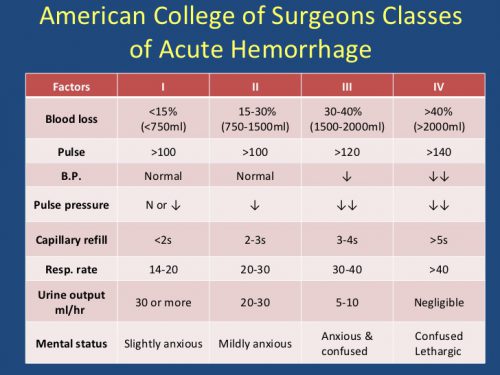
Here’s the table used by the ATLS course:

classes_of_shock

The question you will always be asked is:

What class of hemorrhage (or what % of blood volume loss) is the first to demonstrate systolic hypotension?

This is important because prehospital providers and those in the ED typically rely on systolic blood pressure to figure out if their patient is in trouble.

The answer is Class III, or 30-40%. But how do you remember the damn percentages?

multiscore-maxi1

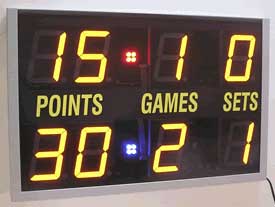
It’s easy! The numbers are all tennis scores. Here’s how to remember them:

Class I up to 15% Love – 15
Class II 15-30% 15 – 30
Class III 30-40 30 – 40
Class IV >40% Game (almost) over!

Bottom line: Never miss that question again!

Best Of EAST 2023 #6: The Best Place To Intubate Bleeding Patients

Forty years ago, the presumption was that the best way to intubate a trauma patient was to take them to a fully equipped operating room and have an anesthesiologist perform it. Then, a few years later, we finally figured out it could be done in the emergency department. The key to doing it safely was that the trauma bay needed to look like an OR, with appropriate airway equipment, lights, and drugs. And you had to ensure that your intubator had sufficient skills.

But we are all too familiar with one subset of trauma patients much more sensitive to the intubation process: those who are bleeding and in shock. They are desperately compensating to attempt to maintain their vital signs as much as they can with their sympathetic tone. Unfortunately, the intubation process and the drugs we use can eliminate this reflex and lead to immediate hemodynamic collapse.

The trauma group at Johns Hopkins postulated that intubation in the ED could lead to worse outcomes in this particular group of patients. They analyzed three years of data from the National Trauma Data Bank dataset, isolating patients at Level I and Level II trauma centers who underwent immediate hemorrhage control surgery after arrival. Patients who were dead on arrival, intubated for airway concerns, or underwent resuscitative thoracotomy were excluded.

The authors used a regression model to determine any association between intubation and mortality. They also analyzed the usual secondary outcomes (complications [cardiac arrest, ARDS, AKI, sepsis], transfusions, and time in the ED).

Here are the factoids:

  • Nearly ten thousand patients at 253 trauma centers met inclusion criteria
  • Most patients were men with penetrating injury
  • One in five underwent intubation in the ED before their hemorrhage control operation and suffered a 17% mortality rate vs. 7% in the OR intubation group, which was a significant difference
  • Median dwell time in the ED was 31 minutes vs. 22 minutes in the OR group
  • Transfusion amount was significantly higher in the ED vs. OR group (6 vs. 4 units RBC)
  • Rates of all complications were significantly higher in the ED vs. OR groups (except sepsis)
  • Overall, cardiac arrest with CPR occurred in 10% of ED vs. 4% OR intubations
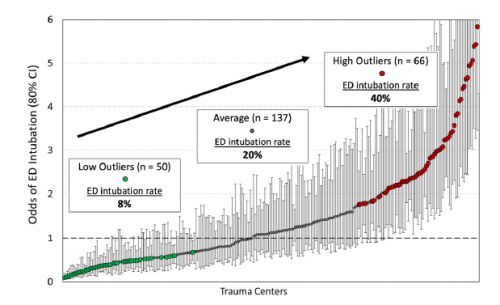
  • Centers that had low ED intubation rates generally had significantly lower post-intubation cardiac arrest events than those with higher ED intubation rates.

The authors concluded that ED intubation of patients requiring hemorrhage control was associated with multiple adverse events. They recommended that these patients be taken to the OR, where both intubation and rapid bleeding control can be achieved.

Bottom line: This nice, clean abstract addresses a simple question. Although it uses a large database, the authors focused on a limited number of variables, keeping the analysis uncomplicated.

The abstract paints a clear picture that agrees with the subjective observations of many trauma professionals that intubation in these patients can be dangerous. They found significant increases in mortality and complications in patients intubated in the ED.

Does this mean that the procedure is not being done as well there? Absolutely not! I believe the key is in the ED dwell time data, which shows an average of 9 more minutes spent there for intubation. Previous research has shown how even a few minutes count when it comes to hemorrhage control. This abstract provides some hard numbers that show how important it really is to get to the OR.

Here are my questions and comments for the presenter/authors:

  • First, a minor point: how can the “median” GCS be 15? Fifteen is the highest it can go. The median is the number where half the results are higher and half are lower. So if no results can be higher, none can be lower. Does this mean that every one of your 10K patients was wide awake?
  • Please explain the figure a little better. Does it just show the mix of low vs. average vs. high ED intubation rates? Or does it go along with the statement that high intubation rate centers have a higher likelihood of cardiac arrest in these patients?
I really enjoyed this abstract and am looking forward to any additional details provided at the presentation.

Reference: EMERGENCY DEPARTMENT VERSUS OPERATING ROOM INTUBATION OF PATIENTS UNDERGOING IMMEDIATE HEMORRHAGE CONTROL SURGERY, EAST 2023 Podium paper #13.
How To Remember Those “Classes of Hemorrhage”

The Advanced Trauma Life Support course lists “classes of hemorrhage”, and various other sources list a similar classification for shock. I’ve not been able to pinpoint where these concepts came from, exactly. But I am sure of one thing: you will be tested on it at some point in your lifetime.

Here’s the table used by the ATLS course:

classes_of_shock

The question you will always be asked is:

What class of hemorrhage (or what % of blood volume loss) is the first to demonstrate systolic hypotension?

This is important because prehospital providers and those in the ED typically rely on systolic blood pressure to figure out if their patient is in trouble.

The answer is Class III, or 30-40%. But how do you remember the damn percentages?

multiscore-maxi1

It’s easy! The numbers are all tennis scores. Here’s how to remember them:

Class I up to 15% Love – 15
Class II 15-30% 15 – 30
Class III 30-40 30 – 40
Class IV >40% Game (almost) over!

Bottom line: Never miss that question again!

Best Of EAST #16: More On TXA

Here’s another abstract dealing with TXA. But this one deals with the classic CRASH-2 use for patients with major bleeding. The original patient showed that TXA improves survival if given within 3 hours of injury. More and more prehospital units (particularly aeromedical services) have been administering TXA enroute to the trauma center to ensure that this drug is given as early as possible.

Many of these same services carry packed cells (or in rare cases, whole blood) so that proper resuscitation can be started while enroute as well. A multicenter group led by the University of Pittsburgh evaluated the utility of giving both TXA and blood during prehospital transport.

Their study summarizes some of the results of the Study of Tranexamic Acid During Air and Ground Medical Prehospital Transport Trial (STAAMP Trial). This study ran from 2015 to 2019 and randomized patients to receive either TXA or placebo during air or ground transport to a trauma center. It included blunt or penetrating patients at risk for hemorrhage within 2 hours of injury who were either hypotensive or tachycardic. Outcome measures included 30-day mortality, 24-hour mortality, and a host of complications.

This abstract outlines a secondary analysis that retrospectively reviewed the impact of using prehospital packed red cells (pRBC) in addition to the TXA/placebo during transport. 

Here are the factoids:

  • There were 763 patients in total, broken down as follows
    • TXA only – 350
    • pRBC only – 35
    • TXA + pRBC – 22
    • Neither – 356
  • Patients who received blood with or without TXA were more severely injured with ISS 22 vs 10-12 in the non-pRBC groups
  • Mortality was higher in the pRBC (23%) and TXA+pRBC groups (29%)
  • TXA alone did not decrease mortality
  • TXA + pRBC resulted in a 46% reduction in 30-day mortality but not at 24 hours
  • packed cells alone decreased 24-hour mortality by 47%

The authors concluded basically what was stated in the results: short term mortality was decreased by pRBC alone, and 30-day mortality with TXA + pRBC. They recommended further work to elucidate the mechanisms involved.

Bottom line: This abstract may also suffer from the “low numbers” syndrome I’ve written about so many times before. The conclusions are based on two small groups that make up only 7% of the entire study group. And these are the two groups with more than double the ISS of the rest of the patients. The authors used some sophisticated statistics to test their hypotheses, and they will need to explain how and why they are appropriate for this analysis. Nevertheless, the mortalities in the blood groups number only in the single digits, so I worry about these statistics.

Here are my questions for the authors and presenter:

  • How do you reconcile the significantly higher ISS in the two (very small) groups who got blood? How might this skew your conclusions regarding mortality? Couldn’t the TXA just be superfluous?
  • How confident are you with the statistical analysis? Could the results be a sampling error given that red cells were given to only 7% of the overall study group?
  • I am having a difficult time understanding the conclusion that mortality was reduced in the blood groups. Specifically, it is stated that 24-hour mortality is reduced by 47% in the blood-only group.  But the mortality is 14% (5 patients)! Reduced 47% from what? I don’t see any other numbers to compare with in the table. Confusing!

Obviously, there must be more information that was not listed in the abstract. Can’t wait to see it!

Reference: PREHOSPITAL SYNERGY: TRANEXAMIC ACID AND BLOOD TRANSFUSION IN PATIENTS AT RISK FOR HEMORRHAGE. EAST 35th ASA, oral abstract #39.


Reference: PREHOSPITAL SYNERGY: TRANEXAMIC ACID AND BLOOD TRANSFUSION IN PATIENTS AT RISK FOR HEMORRHAGE. EAST 35th ASA, oral abstract #39.