Tag Archives: undertriage

Undertriage And Timing Of Your Trauma Activation

By now, most trauma program personnel understand the concept of undertriage. Undertriage occurs when an incoming trauma patient needs a level of care in the emergency department that they don’t get. It could happen if they meet any activation criterion and no activation is called, or if they meet the highest-level criteria and a secondary-level one is called.

Some trauma professionals stop there, using only that binary definition. They met criteria, and the activation didn’t happen. Undertriage. Bad. As with anything in medicine, there are nuances. One of them is the concept of time. What if the patient meets your criteria, but the activation isn’t called right away?

Suppose the patient is hypotensive with a systolic pressure in the 60s on arrival. The emergency physician and a few helpers get to work, establishing IV access and hanging emergency blood. The MTP is activated. The usual initial assessment is carried out. About 20 minutes into the process, the emergency provider performs a FAST and identifies a large hemoperitoneum. He now calls the highest-level activation.

Is this undertriage? Of course. However, I have seen a few PI coordinators review a case like this and not flag it “because a highest-level activation was called.” It would still be undertriage if this patient were activated at the intermediate level before arrival and then upgraded after 20 minutes.

This situation is another example of the PI clock. When analyzing a case, it’s not just a binary decision of “did this happen or not?” It’s when the quality event happened. When does the PI clock start ticking in calling a trauma activation?

The answer is, “when the issue/criterion could first have been known.” What does this mean? When this patient arrives and is first confirmed to meet any criteria, the clock starts. If hypotensive on arrival, the clock starts when the reading is confirmed. If the patient comes in as an intermediate-level activation and becomes hypotensive 30 minutes later, the clock for the highest-level activation starts then.

In the real world, events don’t happen instantaneously. There must be a small grace period to allow the provider to confirm and respond. If the patient is hypotensive on arrival but is awake, alert, and communicating, it is reasonable to confirm the blood pressure to rule out an equipment issue. Once confirmed, it should take only a minute or two to call for the trauma activation.

How long of a grace period should be given? This can be determined by the trauma program, but should be no more than 5-10 minutes.

And what about a situation where an intermediate-level activation is called prior to patient arrival, but they clearly meet the highest-level activation criteria on arrival? The clock starts on arrival.

Bottom line: The undertriage PI clock starts ticking as soon as any criterion is met. If the appropriate level is not called within your brief grace period, then the PI program must flag it as undertriage and investigate.

I’ll further investigate the concept of the PI clock in my next series of posts.


The Cribari Grid And Over/Undertriage

Any trauma performance improvement professional understands the importance of undertriage and overtriage.  Overtriage occurs when a patient who does not meet trauma activation criteria gets one anyway. And undertriage is the converse, where no activation is called despite criteria being met. As you may expect, the latter is much more dangerous for the patient than the former.

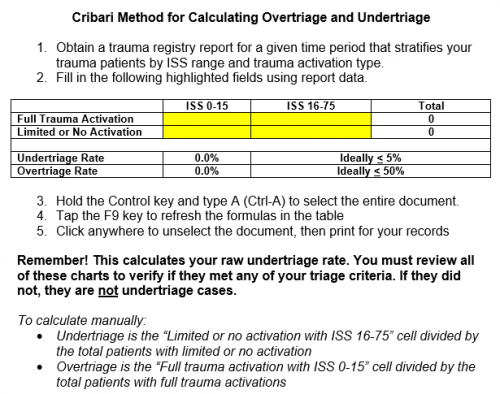
I frequently get questions on the “Cribari grid” or “Cribari method” for calculating these numbers. Dr. Chris Cribari is a former chair of the Verification Review Subcommittee of the ACS Committee on Trauma. He developed a table-format grid that provides a simplified method for calculating these numbers.

But remember, the gold standard for calculating over- and undertriage is examining each admission to see if it met any of your trauma activation triage criteria. The Cribari method is designed for those programs that do not check these on every admission. It is a surrogate that allows you to identify patients with higher ISS who might have benefited from a trauma activation.

So, if you use the Cribari method, use it as a first pass to identify potential undertriage. Then, examine every patient’s chart in the undertriage list to see if they meet your activation criteria. If not, they were probably not undertriaged. However, you must then look at their injuries and overall condition to see if they might have been better cared for by your trauma team. If so, you may need to add a new activation criterion. Then, count that patient as undertriage, of course.

I’ve simplified the calculation process even more and provided a Microsoft Word document that automates the task for you. Just download the file, fill in four values in the table, update the formulas, and you’ve got your numbers! Instructions for manual calculations are also included. Download it by clicking the image below or the link at the end of this post.
cribarigrid

Download the calculator by clicking here

In my next post, I’ll examine how the NFTI score (need for trauma intervention) fits into the undertriage/overtriage calculations.

NFTI And STAT: Can They Replace The Cribari Grid?

In my last post, I reviewed using the Cribari grid to evaluate over- and under-triage at your trauma center.  This technique has been a mainstay for nearly two decades but has shortcomings. The most important one is that it relies only on the Injury Severity Score (ISS) to judge whether some type of mistriage occurred.  The ISS is usually calculated after discharge, so it can only be applied after the fact. And its correlation with outcomes varies.

What is NFTI, Exactly?

Five years ago, the Baylor University in Dallas group sought to develop an alternate method of determining who needed a full trauma team activation. They chose resource utilization as their surrogate to select these cases. They reviewed 2.5 years of their registry data (Level I center).  After several iterations, they settled on six “need for trauma intervention” (NFTI) criteria:

  • blood transfusion within 4 hours of arrival
  • discharge from ED to OR within 90 minutes of arrival
  • discharge from ED to interventional radiology (IR)
  • discharge from ED to ICU AND ICU length of stay at least three days
  • require mechanical ventilation during the first three days, excluding anesthesia
  • death within 60 hours of arrival

Patients who had at least one NFTI criterion were considered candidates for full trauma activation, and if an activation did not occur, the encounter would be regarded as undertriage. On the flip side, if no NFTI criteria were present and an activation did occur, it would be overtriage.

The First NFTI Paper

In their first published paper, the Baylor group analyzed nearly 5,000 trauma activations, split roughly in half for full versus partial trauma activations. Two-thirds of the full activations met at least one NFTI criterion. This means that about a third might be considered overtriage since they did not require one of the critical resources or die within 60 hours of arrival. And looking at the partial activations, fully 75% did not meet any NFTI criteria. There were 561 deaths in the overall group (12%). Of those, only 13 did not meet any NFTI criteria, but every one had a DNR order in place.

Now let’s translate all this into under- and overtriage numbers:

  • Undertriage: 22% (partial activations that were NFTI +)
  • Overtriage: 58% (any level of activation in a NFTI – patient)

The authors concluded that NFTI assesses anatomy and physiology using only measures of early resource utilization. They believe that it self-adjusts for age, frailty, and comorbidities and is a simple and effective tool for identifying major trauma patients.

But is it better for evaluating over- and undertriage than the Cribari grid? I’ve had several people tell me that it is. But if you look at the numbers above, overtriage is in the usual range, and undertriage is higher than the usual raw Cribari numbers. Even the authors suggest that it might be used to determine if the patient needed a trauma activation. Up to this point, NFTI is interesting, but not better than Cribari on its own.

The following year, these authors published a paper that further refined their concept. They rolled NFTI into something called the Standardized Triage Assessment Tool (STAT). Basically, the Cribari matrix is applied to the trauma activation data as usual. The fallouts (over- and undertriage groups) are then tested against the NFTI criteria. Cribari undertriage patients who were NFTI negative were now considered appropriate triage, as were Cribari overtriage who were NFTI positive. NFTI was basically used to do another level of screening on the outliers before resorting to individual chart review.

Once again, let’s look at over- and undertriage experience in the paper:

  • Undertriage: 9.1% undertriage (Cribari) reduced to 3.3% by adding STAT
  • Overtriage: 50% overtriage (Cribari) reduced to 31% by adding STAT

The authors concluded that adding STAT to the review process tightens up the numbers, reducing the number of charts that need to be reviewed individually. It also standardizes comparisons between hospitals that use STAT. This may be helpful for future triage-related research.

What Does It All Mean?

The Cribari grid has been around a long time, and people are both comfortable and facile using it. But it does tend to overestimate undertriage. In my experience, the raw Cribari undertriage rate is usually 12-22%. Individual chart analysis reduces this by about 10%. Overtriage rates are anywhere from 40% to 90%, and most centers do not review those charts because they don’t care much about reducing it.

Applying NFTI criteria to the over- and undertriage fallouts from Cribari makes sense. It appears to appropriately reduce both rates significantly. Undertriage remains the most significant factor to monitor. If you choose to adopt the use of the STAT technique, consider manually reviewing the undertriage charts that are being reclassified as appropriate for a few cycles. This should help confirm that STAT is really working for you.

One last thing. Using Cribari or NFTI or STAT does not absolve you of having good triage criteria for trauma activations. It is not possible to know a patient’s ISS or NFTI status as they are rolling through the door. The quality of your activation criteria are the first screen to try to ensure appropriate triage. If you keep finding undertriage events occurring, first look at your criteria. If those seem to be fine, then it’s time to scrutinize the people applying them!

Helpful Tools

The authors of the STAT paper provided some Excel spreadsheets to help add the Cribari matrix, NFTI, or STAT to your registry. Note that this only works for TraumaBase! If you use a different registry, contact your vendor for assistance.

The spreadsheets consist of three tabs/pages. On the first, enter the specific field names from your TraumaBase implementation. This fills in the code on the second tab which will be added to TraumaBase. The third tab gives explicit directions on how to add the feature to your registry.

Here are the downloadable file links provided by the authors:

References:

  1. Asking a Better Question: Development and Evaluation of the Need For Trauma Intervention (NFTI) Metric as a Novel Indicator of Major Trauma. J Trauma Nursing 24(3):150-157, 2017.
  2. Avoiding Cribari gridlock: The standardized triage assessment tool improves the accuracy of the Cribari matrix method in identifying potential overtriage and undertriage. J Trauma Acute Care Surg. 2018 May;84(5):718-726.

Undertriage And Overtriage: The Cribari Grid

Any trauma performance improvement professional understands the importance of undertriage and overtriage. Overtriage occurs when a patient who does not meet trauma activation criteria gets one anyway. And undertriage is the converse, where no activation is called despite criteria being met. As you may expect, the latter is much more dangerous for the patient.

I frequently get questions on the “Cribari Grid” or “Cribari Method” for calculating these numbers. Dr. Chris Cribari was a previous chair of the Verification Review Committee of the ACS Committee on Trauma. He developed a table-format grid that provides a simplified method for calculating these numbers.

But remember, the gold standard for calculating over- and undertriage is examining each admission to see if they actually met any of your trauma activation triage criteria. The Cribari method is designed for those programs that do not or cannot check these on every admission. And since most programs have too many trauma admissions to verify every single one, the grid technique can be very helpful. It is a surrogate for chart review that helps reduce the workload to identify patients with higher ISS that might have benefited from a trauma activation.

If you use the Cribari method, use it as a first pass to identify potential undertriage. In most trauma programs, the raw undertriage number using the grid will be around 10-20%. Obviously, this is unacceptably high. It requires the second pass: manually examining the chart of every patient in the undertriage list to see if they meet any of your activation criteria. If they did not, they would most likely not have been undertriaged. The second pass process usually decreases the undertriage rate by about 10%, usually reducing it below the acceptable threshold of 5%

But now you need to do a third pass. Look at each patient’s injuries and overall condition to ask yourself if they might have been better cared for by your entire trauma team. Even though they don’t meet any of your existing criteria, should they have? If so, you may need to add a new activation criterion. Then, count that patient as undertriage, of course.

I’ve simplified the Cribari Grid calculation process as much as possible and have provided a Microsoft Word document that automates the task. Just download the file, fill in the four highlighted values in the table, update the formulas using the instructions, and voila! You’ve got your numbers! Instructions for manual calculations are also included. Download it by clicking the image below or the link at the end of this post.

In my next post, I’ll examine how the NFTI score (Need For Trauma Intervention) fits into your undertriage calculations.

Click here to download the calculator.

The Cribari Grid And Over/Undertriage

Any trauma performance improvement professional understands the importance of undertriage and overtriage.  Overtriage occurs when a patient who does not meet trauma activation criteria gets one anyway. And undertriage is the converse, where no activation is called despite criteria being met. As you may expect, the latter is much more dangerous for the patient than the former.

I frequently get questions on the “Cribari grid” or “Cribari method” for calculating these numbers. Dr. Chris Cribari is a previous chair of the Verification Review Subcommittee of the ACS Committee on Trauma. He developed a table-format grid that provides a simplified method for calculating these numbers.

But remember, the gold standard for calculating over- and undertriage is examining each admission to see if they met any of your trauma activation triage criteria. The Cribari method is designed for those programs that do not check these on every admission. It is a surrogate that allows you to identify patients with higher ISS that might have benefited from a trauma activation.

So if you use the Cribari method, use it as a first pass to identify potential undertriage. Then, examine the chart of every patient in the undertriage list to see if they meet any of your activation criteria. If not, they were probably not undertriaged. However, you must then look at their injuries and overall condition to see if they might have been better cared for by your trauma team. If so, perhaps you need to add a new activation criterion. And then count that patient as undertriage, of course.

I’ve simplified the calculation process even more and provided a Microsoft Word document that automates the task for you. Just download the file, fill in four values in the table, update the formulas and voila, you’ve got your numbers! Instructions for manual calculations are also included. Download it by clicking the image below or the link at the end of this post.

cribarigrid

Download the calculator by clicking here

In my next post, I’ll examine how the NFTI score (need for trauma intervention) fits into the undertriage/overtriage calculations.

Related posts: