
Tag Archives: trauma team

Do I Have To Call My Trauma Team For Incoming Transfers?

All trauma centers receive transfers  from referring hospitals. Often, a portion of the workup has already been completed at that hospital. If the patient meets one or more of your trauma activation criteria, do you still need to activate your team when they arrive?

And the answer is: sometimes. But probably not that often.

Think about it. You should activate your team if you suspect the patient may have an injury requiring rapid diagnosis and treatment. The purpose of any trauma activation is speed. Rapid evaluation. Fast lab results. Quick access to CT scan or OR. If a significant amount of time has already passed (transported to an outside hospital, worked up for an hour or two, then transported to you), then it is less likely that a trauma activation will benefit the patient.

There are four classes of trauma activation criteria. I’ll touch on each one and the need to activate in a delayed fashion if present, in priority order.

  • Physiologic. If there is a significant disturbance in vital signs while in transit to you (hypotension, tachycardia, respiratory problems, coma), then you must activate. Something else is going on that needs to be corrected as soon as the patient arrives. And remember the two mandatory ACS criteria that fall into this category: respiratory compromise/need for an emergent airway, and patients receiving blood to maintain vital signs. But a patient who needed an airway who is already intubated and no longer compromised does not need to be a trauma activation.
  • Anatomic. Most simple anatomic criteria (e.g., long bone or pelvic fractures) do not need a trauma activation unless the patient is beginning to show signs of physiologic compromise. However, anatomic criteria that require rapid treatment or access to the OR (proximal amputations, mangled or pulseless extremities, spinal cord injury) should be activated.
  • Mechanism. Most of the vague mechanistic criteria (falls, pedestrian struck, vehicle intrusion) do not require trauma activation after transfer to you. But once again, if the mechanism suggests a need for further rapid diagnosis or treatment (penetrating injury to abdomen), then activate.
  • Comorbidities. This includes underlying diseases, extremes of age, and pregnancy. In general, these will not require trauma activation after they arrive.

Bottom line: In many cases, the patient transferred in from another hospital will not need to be a trauma activation, especially if they have been reasonably assessed there. The patient should be rapidly eyeballed by your emergency physicians, and if there is any doubt about their condition, activate then.

However, if little workup was done at the outside hospital (my preference), and the injuries are “fresh” (less than a few hours old), then definitely call your team. 

Do I Have To Call My Trauma Team For Incoming Transfers?

Some trauma centers receive a significant number of transfers from referring hospitals. Much of the time, the outside hospital has already done a portion of the workup. If the patient meets one or more of your trauma activation criteria, do you still need to activate your team when they arrive?

And the answer is: sometimes. But probably not that often.

Think about it. You should be activating your team because you suspect the patient may have an injury that demands rapid diagnosis and treatment. The purpose of any trauma activation is speed. Rapid evaluation. Fast lab results. Quick access to CT scan or OR. If a significant amount of time has already passed (transported to an outside hospital, worked up for an hour or two, then transported to you), then it is less likely that a trauma activation will benefit the patient.

There are four classes of trauma activation criteria. I’ll touch on each one and the need to activate in a delayed fashion if present, in priority order.

  • Physiologic. You must activate if there is a significant disturbance in vital signs while in transit to you (hypotension, tachycardia, respiratory problems, coma). Something else is going on that needs to be corrected as soon as the patient arrives. And remember the two mandatory ACS criteria that fall into this category: respiratory compromise/need for an emergent airway, and patients receiving blood to maintain vital signs. But a patient who needed an airway who is already intubated and no longer compromised does not need to be a trauma activation.
  • Anatomic. Most simple anatomic criteria (e.g., long bone or pelvic fractures) do not need a trauma activation unless the patient is beginning to show signs of physiologic compromise. However, anatomic criteria that require rapid treatment or access to the OR (proximal amputations, mangled or pulseless extremities, spinal cord injury) should be activated.
  • Mechanism. Most of the vague mechanistic criteria (falls, pedestrian struck, vehicle intrusion) do not require trauma activation after transfer to you. But once again, if the mechanism suggests a need for further rapid diagnosis or treatment (penetrating injury to abdomen), then activate.
  • Comorbidities. This includes underlying diseases, extremes of age, and pregnancy. In general, these will not require trauma activation after they arrive.

Bottom line: In many cases, the patient transferred in from another hospital will not need to be a trauma activation, especially if they have been reasonably assessed there. The patient should be rapidly eyeballed by your emergency physicians, and if there is any doubt about their condition, activate then.

However, if little workup was done at the outside hospital (my preference), and the injuries are “fresh” (less than a few hours old), then definitely call your team. 

And finally, if the patient meets any of the ACS hard criteria for activation (this includes hypotension, transfusing blood, and respiratory compromise), don’t hesitate to trigger the activation!
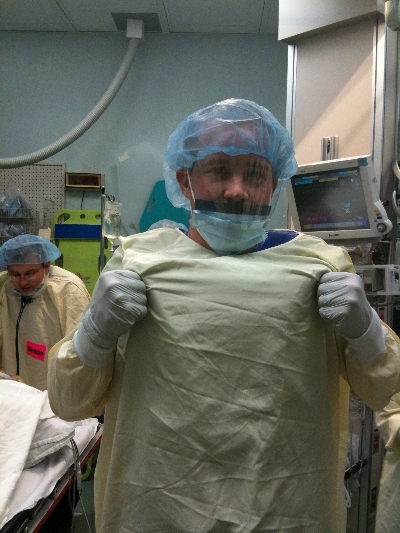
Do I Have To Call My Trauma Team For Incoming Transfers?

Some trauma centers receive a significant number of transfers  from referring hospitals. Much of the time, a portion of the workup has already been done by the outside hospital. If the patient meets one or more of your trauma activation criteria, do you still need to activate your team when they arrive?

And the answer is: sometimes. But probably not that often.

Think about it. The reason you should be activating your team is that you suspect the patient may have an injury that demands rapid diagnosis and treatment. The purpose of any trauma activation is speed. Rapid evaluation. Fast lab results. Quick access to CT scan or OR. If a significant amount of time has already passed (transported to an outside hospital, worked up for an hour or two, then transported to you), then it is less likely that a trauma activation will benefit the patient.

There are four classes of trauma activation criteria. I’ll touch on each one and the need to activate in a delayed fashion if present, in priority order.

  • Physiologic. If there is a significant disturbance in vital signs while in transit to you (hypotension, tachycardia, respiratory problems, coma), then you must activate. Something else is going on that needs to be corrected as soon as the patient arrives. And remember the two mandatory ACS criteria that fall into this category: respiratory compromise/need for an emergent airway, and patients receiving blood to maintain vital signs. But a patient who needed an airway who is already intubated and no longer compromised does not need to be a trauma activation.
  • Anatomic. Most simple anatomic criteria (e.g. long bone or pelvic fractures) do not need a trauma activation unless the patient is beginning to show signs of physiologic compromise. However, anatomic criteria that require rapid treatment or access to the OR (proximal amputations, mangled or pulseless extremities, spinal cord injury) should be activated.
  • Mechanism. Most of the vague mechanistic criteria (falls, pedestrian struck, vehicle intrusion) do not require trauma activation after transfer to you. But once again, if the mechanism suggests a need for further rapid diagnosis or treatment (penetrating injury to abdomen), then activate.
  • Comorbidities. This includes underlying diseases, extremes of age, and pregnancy. In general, these will not require trauma activation after they arrive.

Bottom line: In many cases, the patient transferred in from another hospital will not need to be a trauma activation, especially if they have been reasonably assessed there. The patient should be rapidly eyeballed by your emergency physicians, and if there is any doubt about their condition, activate then.

However, if little workup was done at the outside hospital (my preference), and the injuries are “fresh” (less than a few hours old), then definitely call your team. 

And finally, if the patient meets any of the ACS hard criteria for activation (this includes hypotension, transfusing blood, and respiratory compromise), don’t hesitate to trigger the activation!

Paying Respect After A Terminal Trauma Activation

As all trauma professionals know, traumatic injuries are a major cause of death across all age groups. Well-trained trauma teams use all their skills to attempt to save critically injured patients. But, unfortunately, there are occasions in which they die despite all our efforts. In most of these cases, the time of death is called, and team members then peel off their protective clothing and melt away to pursue their usual duties.

These terminal trauma activations are mentally challenging as the proper interventions are ordered and carried out. They are also physically demanding, especially when heroic measures such as CPR are needed. But one often-neglected issue is the emotional challenge. Every team member is invested in saving that person. Frequently, they can visualize their own spouse, parent, or child in place of the patient, and go all out to try to save them.

When these trauma activations are over, team members frequently do not have an opportunity to resolve their own emotional turmoil or achieve closure for the turmoil of the previous 30 minutes.

A recent paper from the Gunderson Health System in La Crosse, Wisconsin, studied a practice that seeks to achieve this closure and recognize the life of the deceased patient. They call this the PAUSE, an acronym for Promoting Acknowledgment, Unity, and Sympathy at the End of life.

This process was implemented about five years ago, and a multidisciplinary team from a variety of religious backgrounds and beliefs carefully worded the script. It works like this:

  1. The team leader calls the time of death.
  2. Team leader then states, “At this time, we would like to take a moment to honor the patient and staff.”
  3. A chaplain takes over and does the following:
    • (Chaplain states) For those who would like to stay,
      we’ll take a moment of silence to acknowledge this
      person, their death, and our care for them …
    • (Moment of silence—10 s)
    • (Blessing)
      We give thanks for ___(Name), those they loved, and
      those who loved them.
      We give thanks for the privilege of caring for them.
      We give thanks for our caring team.
      We ask that all may be whole and find peace. Amen.
    • (Chaplain states) Thank you for your care—for those
      who would like to stay, please do, for those moving
      on to other duties, Thank You.
  4. The team disperses.

The research group circulated a pre-implementation questionnaire and then sent a post-implementation questionnaire two years later. The questionnaires were the same, except six additional questions regarding experience with PAUSE were added to the post-survey.

Here are the factoids:

  •  There were 466 participants in this study; the number of patients treated was not stated
  • Participation rates were typical of questionnaire studies (40% pre-surveys and 23% post-surveys)
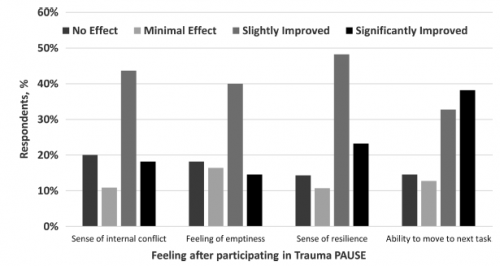
  • While not statistically significant, many team members reported improvements in internal conflict, feelings of emptiness, resilience, and ability to move on to the next task

Note the higher slightly and significantly improved feelings in the post-study. This chart was based on 57 respondents.

The authors concluded that the PAUSE process was a meaningful way to help trauma team members emotionally.

Bottom line: Studies like this are difficult to conduct and even more challenging to apply rigorous statistical methods. They frequently do not have statistically significant results. But one can see specific improvements despite the soft numbers. 

Many hospitals have some processes for terminal trauma activations. Most are not as well-scripted as this. But having been involved in them myself, I find it very helpful and comforting. I recommend all centers consider implementing something similar. Like most practice guidelines, this one is only suitable for adoption with adaptation. When adopting this, it is essential to work with your chaplains and recognize the specific ethnic and religious representation in your trauma center.

Reference: Trauma and Death in the Emergency Department: A Time to PAUSE (Promoting Acknowledgment, Unity, and Sympathy at the End of Life). J Trauma Nursing 29(6):291-297, 2022.

Do I Have To Call My Trauma Team For Incoming Transfers?

I had a great question sent in by a reader last week:

Some trauma centers receive a number of transfers  from referring hospitals. Much of the time, a portion of the workup has already been done by that hospital. If the patient meets one or more of your trauma activation criteria, do you still need to activate your team when they arrive?

And the answer is: sometimes. But probably not that often.

Think about it. The reason you should be activating your team is that you suspect the patient may have an injury that demands rapid diagnosis and treatment. The purpose of any trauma activation is speed. Rapid evaluation. Fast lab results. Quick access to CT scan or OR. If a significant amount of time has already passed (transported to an outside hospital, worked up for an hour or two, then transported to you), then it is less likely that a trauma activation will benefit the patient.

There are four classes of trauma activation criteria. I’ll touch on each one and the need to activate in a delayed fashion if present, in priority order.

  • Physiologic. If there is a significant disturbance in vital signs while in transit to you (hypotension, tachycardia, respiratory problems, coma), then you must activate. Something else is going on that needs to be corrected as soon as the patient arrives. And remember the two mandatory ACS criteria that fall into this category: respiratory compromise/need for an emergent airway, and patients receiving blood to maintain vital signs. But a patient who needed an airway who is already intubated and no longer compromised does not need to be a trauma activation.
  • Anatomic. Most simple anatomic criteria (e.g. long bone or pelvic fractures) do not need a trauma activation unless the patient is beginning to show signs of physiologic compromise. However, anatomic criteria that require rapid treatment or access to the OR (proximal amputations, mangled or pulseless extremities, spinal cord injury) should be activated.
  • Mechanism. Most of the vague mechanistic criteria (falls, pedestrian struck, vehicle intrusion) do not require trauma activation after transfer to you. But once again, if the mechanism suggests a need for further rapid diagnosis or treatment (penetrating injury to abdomen), then activate.
  • Comorbidities. This includes underlying diseases, extremes of age, and pregnancy. In general, these will not require trauma activation after they arrive.

Bottom line: In many cases, the patient transferred in from another hospital will not need to be a trauma activation, especially if they have been reasonably assessed there. The patient should be rapidly eyeballed by your emergency physicians, and if there is any doubt about their condition, activate then.

However, if little workup was done at the outside hospital (my preference), and the injuries are “fresh” (less than a few hours old), then definitely call your team.