Tag Archives: orthopedic surgery

How To Spare Your Consultants: Orthopedic Surgery

In US Level I and Level II trauma centers, the trauma surgeons must typically stay in the hospital to be ready for incoming major trauma patients. But most of our specialty colleagues have the luxury of sleeping at home. They are immediately available when needed, and we know it.

One thing that has struck me over the years is our reflex to call our consultants as soon as we find a diagnosis in their specialty. Even at 2:00 am. And even when we know they won’t see the patient until the morning.

Why do we do this? Specialty coverage is increasingly difficult to secure for many centers. Why not use our specialist colleagues more intelligently so we don’t burn them out?

About half of the major injuries seen at a trauma center require some type of orthopedic surgery management. When consulting your orthopedic surgeon (or any other specialty service), always keep the patient’s best interests paramount in your decision-making. Then think about how soon and under what context they really need to see the patient. Can it wait until morning? Do they even really need to be seen in the ED, or can this be an outpatient visit?

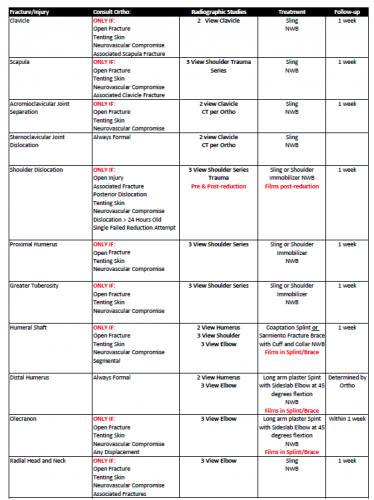
I’ve created a cheat sheet to help you decide whether you need your orthopod now, in the morning, or if the patient can be seen in their office in a few days. Because orthopedics is such a broad area, this sheet is a bit lengthy. But I think you will find it quite valuable.

Note: Before implementing this guideline, run it by your orthopedic surgeons to see if their preferences for some of the fractures are different from those listed.

Click on the image below to download the full guideline.

In the next post: Expectations on how your consultants should conduct themselves when seeing your patients.

When To Call: Orthopedic Surgery

And here’s the last in my short “When To Call” series. This one’s a little different, and quite a bit longer. That’s due to the complexity and sheer number of potential orthopedic problems.

When consulting a specialty service, always keep the patient paramount in your decision making. Then think about how soon and under what context they really need to see the patient. Can it wait until morning? Do they even really need to be seen in the ED, or can this be an outpatient visit?

Tomorrow: Expectations on how your consultants should go about their business when seeing your patients.

Trauma Centers: The 30-Minute Rules for Orthopedic Surgery and Neurosurgery

I’m kicking of a week-long series for trauma program leaders that explains the details of a trauma center requirement that creates confusion for many. With the adoption of the 2014 Resources for Optimal Care of the Injured Patient (i.e. The Orange Book), a number of new requirements were introduced to obtain and maintain status as an American College of Surgeons verified trauma center. One (or actually two) of the requirements for Level I and II centers are known collectively as the 30-minute rules.

The 30-minute rules apply to both orthopedic surgeons and neurosurgeons. They state that care must be continuously available and that a service representative “must be present and respond within 30 minutes based on institutional-specific criteria.” And most who peruse the Orange Book have already realized, any phrase that contains the word must denotes that failure to meet the requirement will result in a deficiency during a site review, whereas the word shall means that it will likely result in a weakness.

For the rest of the week, I’ll work through these requirements. I will describe what they mean and what some typical institutional-specific criteria are. I will explain who is actually required to respond. I’ll work through the logistics of being able to accurately record their response time, and offer best practices for how to capture it. And finally, I’ll look at the consequences of not meeting these criteria.

Tomorrow: Typical criteria for orthopedic surgery and orthopedics.


Benefits Of A Dedicated Ortho Operating Room For Trauma

Level I and II trauma centers that are verified by the American College of Surgeons are required to have a method for ensuring that urgent orthopedic cases have good access to an operating room (OR). Some hospitals (that have room availability) have achieved this by dedicating an OR for this purpose. In a few hospitals, the room is available 24/7, but most provide daily block time that has a reasonable release time (typically about 6am). This allows procedures to reliably get done the next morning.

Previous papers have documented many of the benefits of this practice: decreased length of stay, fewer surgical revisions, decreased cost, and of course, fewer after-hours operations. But by definition, this adds a delay of several hours to the case. If the patient comes in at 7pm, the case may not start for 12 hours or more.

Could this increase the risk of infection or other complications? The orthopedic group at Stormont Vail in Topeka KS (Level I) looked at their retrospective experience over a 6 year period. They specifically examined cases in which a time delay could increase the infection rate: open tib/fib fractures. They recorded the usual demographics, time to procedure, and broke the data down by Gustilo grade of the fracture.

Here are the factoids:

  • The authors treated 297 patients with a total of 347 open fractures
  • About half were treated before a dedicated ortho OR was implemented, and half after
  • Average time to debridement in the dedicated OR was 13 hours, vs 5 hours in the on-call system
  • Overall, the number debrided within 24 hours was the same in both groups
  • Primary fracture union was significantly higher in the dedicated room group (73% vs 57%)
  • Patients treated initially in the dedicated room were significantly less likely to need an unplanned procedure later (for malunion or infection)
  • There was no difference in infection, non-union, or amputation rates

Bottom line: Let your orthopedic surgeon sleep if you have a dedicated OR so the work can get done first thing the next day! It saves wear and tear on the hospital infrastructure that occurs when cases are done in the middle of the night, as well as the surgeon. Besides saving time and money, final outcomes are better, too!

Reference: Use of the Dedicated Orthopaedic Trauma Room for Open Tibia and Femur Fractures: Does It Make a Difference? J Ortho Trauma 32(8):377-380, 2018.

Video: How To Reduce An Ankle Dislocation

Here’s another fun video. It’s directed to emergency physicians and orthopedic surgeons who have to manage ankle dislocations. It will show you the following:

  • Types of ankle dislocation
  • Reduction
  • Splinting
  • The Quigley maneuver
  • How to apply the Sugartong splint
  • Lots of practical tips!

The video was broadcast at a previous Trauma Education: The Next Generation conference, and features Sarah Anderson MD, an orthopedic surgeon at Regions Hospital.

[embedyt] http://www.youtube.com/watch?v=8hodXLUHwLw[/embedyt]