Tag Archives: algorithm

The Modified Brain Injury Guideline Criteria (mBIG)

In my previous post, I reviewed the Brain Injury Guideline criteria (BIG) that were published in 2014, and cited some early papers promoting its use for simplifying neurotrauma care. These criteria allowed trauma professionals to use our neurosurgical colleagues’ services more sensibly.

As a reminder, these are the original BIG criteria:

Some revisions were proposed in 2020 to improve patient safety and reproducibility further.  Here are the revised criteria:

So, what are the differences?

  • The “loss of consciousness” was changed to a more objective assessment, the GCS
  • Intoxication is defined as a blood alcohol concentration > 80 mg/dL
  • Aspirin and NSAIDs are not considered antiplatelet agents
  • Epidural hematoma (EDH) is no longer sized; any epidural moves the patient to mBIG 3
  • Multiple intraparenchymal hemorrhages (IPH) move the patient to mBIG 3
  • Subarachnoid hemorrhage is more objectively classified

The mBIG criteria were tested in a multi-institutional review comparing the original criteria with the modified criteria. BIG 3 patients were excluded, since these patients required admission and neurosurgical consultation, which is maximal therapy. All patients underwent repeat CT scans to monitor for progression of the injury.

Here are the factoids:

  • A total of 269 patients were included; 98 were BIG 1 and 171 were BIG 2
  • In both BIG 1 and BIG 2 cohorts, CT progression was seen in about 11% of patients. These patients tended to have more severe injuries overall and were more likely to have EDH or IPH.
  • Two BIG 2 patients decompensated and required neurosurgical intervention; both had EDH

These findings prompted the changes that are now part of the mBIG score. Here is the complete algorithm based on the mBIG criteria (click to see full-size):

A larger validation study was published in 2022 by the same authors, following the addition of 496 patients from the same three trauma centers. The total number of patients included in the study was 496.

More factoids:

  • There were now a total of 223 mBIG 1 patients and 273 mBIG2
  • The number of CT scans and neurosurgery consults was significantly decreased
  • Hospital length of stay was also significantly decreased

Bottom line: The mBIG criteria perform better and are at least as safe as the initial BIG criteria. The mBIG criteria are more objective, making it easier to stratify patients accurately. 

The mBIG criteria should be adopted by any center seeking a consistent and validated process for stratifying patients for observation, admission, or neurosurgical consultation following head trauma. This will conserve resources and allow our neurosurgical colleagues to focus on the patients who truly need them.

References:

  1. Multicenter assessment of the Brain Injury Guidelines and a proposal of guideline modifications. Trauma Surgery & Acute Care Open, 5(1), e000483.
  2. A multicenter validation of the modified brain injury guidelines: Are they safe and effective?. Journal of Trauma and Acute Care Surgery 93(1):p 106-112, July 2022.

The BIG Brain Injury Guidelines

Until five years ago, there was tremendous variability in the way brain injuries were managed at trauma centers. There were no clear guidelines describing what should be done during the initial evaluation, and no consensus as to when to involve neurosurgery. This resulted in a lot of flailing about and unnecessary calls to our neurosurgical colleagues.

Then the Brain Injury Guidelines (BIG) came along 15 years ago. They were developed to allow trauma programs to stratify head injuries in such a way as to better utilize resources such as hospital beds, CT scanning, and neurosurgical consultation.

Injuries are stratified into three BIG categories, and management is based on them. Here is the stratification algorithm:

And here is the management algorithm based on the stratification above:

(RHCT = repeat head CT)

The original study was published ten years ago and was a retrospective review of 4,000 patient records. It found that a significant number of these patients could be managed exclusively by the trauma surgeons.

The AAST BIG Multi-Institutional Group set about prospectively validating this system to ensure that it was accurate and safe. They identified adult patients from ten high level trauma centers that had a positive initial head CT scan. They looked at the the need for neurosurgical intervention, change in neuro exam, progression on repeat head CT, any visits to the ED after discharge, and readmission for the injury within 30 days.

Here are the factoids:

  • About 2,000 patients were included in the study, with BIG1 = 15%, BIG2 = 15%, and BIG3 = 70% of patients
  • BIG1: no patients worsened, 1% had progression on CT, none required neurosurgical intervention, no readmits or ED visits
  • BIG2: 1% worsened clinically, 7% had progression on CT, none required neurosurgical intervention, no readmits or ED visits
  • All patients who required neurosurgical intervention were BIG3 (20% of patients)

The authors concluded that using the BIG criteria, CT scan use and neurosurgical consultation would have been decreased by 29%.

Bottom line: This is an exciting paper! BIG has been around for awhile, and some centers have already started using it for planning the management of their TBI patients. This study provides some validation that the system works and keeps patients safe while being respectful of resource utilization. 

My only criticism is that the number of patients in the BIG1 and BIG2 categories is low (about 600 combined). Thus, our experience in these groups remains somewhat limited. However, the study is very promising, and more centers should consider adopting BIG to help them refine their management of TBI patients. 

This was the first prospective study of the BIG criteria. A great deal of additional work has been done. And now, an attempt has been made to simplify this algorithm even further.

In my next post, I’ll review the modified BIG (mBIG) criteria and describe them in detail.

References:

  1. The BIG (brain injury guidelines) project: defining the management of traumatic brain injury by acute care surgeons. Journal of Trauma and Acute Care Surgery, 76(4), 965-969.
  2. Validating the Brain Injury Guidelines: Results of an American Association for the Surgery of Trauma prospective multi-institutional trial. J Trauma Acute Care Surg. 2022 Aug 1;93(2):157-165.

You’ve Been Pimped!

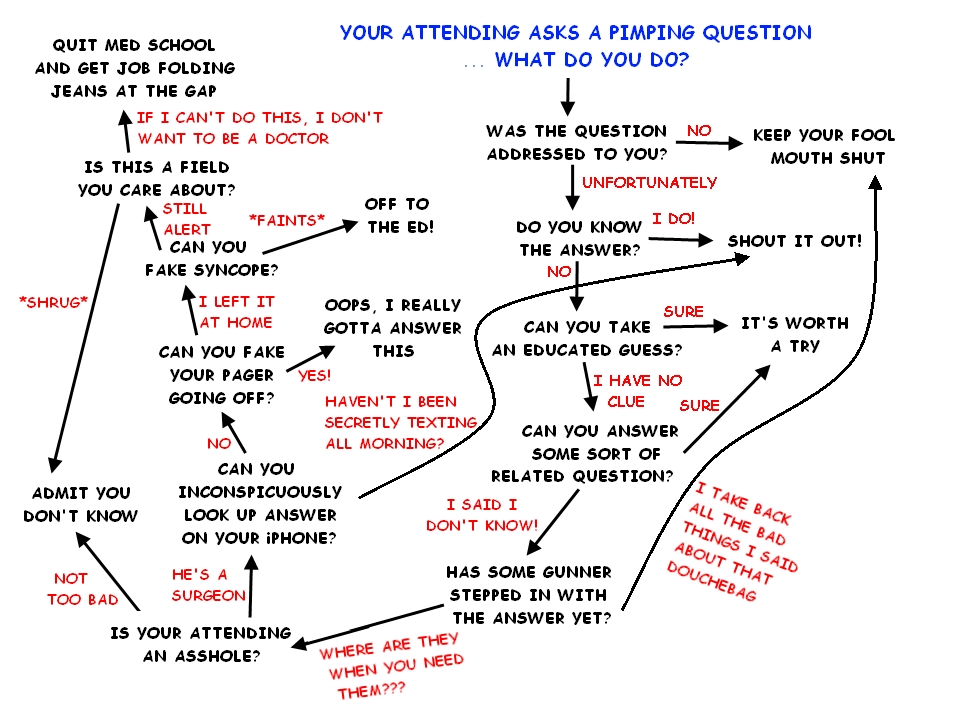
You know what I’m talking about. It’s a mainstay of medical education for physicians. It starts in medical school, and generally never stops. And when you finish your residency,  you graduate from being pimped to being the pimper.

How did this all come to be? Is it good for education? Bad? Tune in tomorrow to learn more. In the meantime, enjoy this algorithm on how to get through a pimping session. Click to view full-size.

pimping

Source: Posted by Dr. Fizzy on The Almost Doctor’s Channel

You’ve Been Pimped!

You know what I’m talking about. It’s a mainstay of medical education for physicians. It starts in medical school, and generally never stops. And when you finish your residency,  you graduate from being pimped to being the pimper.

How did this all come to be? Is it good for education? Bad? Tune in tomorrow to learn more. In the meantime, enjoy this algorithm on how to get through a pimping session. Click to view full-size.

pimping

Source: Posted by Dr. Fizzy on The Almost Doctor’s Channel

You’ve Been Pimped!

You know what I’m talking about. It’s a mainstay of medical education for physicians. It starts in medical school, and generally never stops. And when you finish your residency,  you graduate from being pimped to being the pimper.

How did this all come to be? Is it good for education? Bad? Tune in tomorrow to learn more. In the meantime, enjoy this algorithm on how to get through a pimping session. Click to view full-size.

pimping

Source: Posted by Dr. Fizzy on The Almost Doctor’s Channel