
Tag Archives: bullet

Falling Bullets: What Goes Up…

I recently reviewed a case of a person walking outside during fireworks who experienced something strike the top of his head. He could feel something solid stuck in his scalp and thought a piece of a firework had hit him. But then he noticed that people nearby were shooting guns into the air. He also noted a slight weakness and numbness in his upper extremity.

He rapidly proceeded to his local emergency department. Sure enough, physical exam and CT scan revealed a small caliber bullet partially embedded in the top of his skull, with a small contusion in the frontoparietal area. Neurosurgery removed the projectile without incident, and the dura was intact. His neurologic symptoms improved but did not fully disappear before discharge.

This whole situation made me curious. How big a problem is this? How dangerous are bullets fired in the air? The first paper I could find in the trauma literature dates back to 1994 in the Journal of Trauma. The authors presented a series of 118 patients struck by falling projectiles over 10 years. The majority of patients were struck in the head (77%), and the mortality was 32%!

An interesting case report described a male who was watching fireworks who presented to the ED with chest pain and dyspnea.

The terminal velocity of bullets varies based on their size and shape. It ranges from 200-300 ft/sec, or 140-200 mph! Although these numbers are lower than the initial muzzle velocity, they are quite high and comparable to the velocity of a high-powered pellet gun. But with a much heavier projectile. On exam, a penetrating injury was seen above the nipple on the left chest. The abdominal x-ray showed this:

He was taken for laparotomy, and injuries to the splenic hilum, stomach, and diaphragm were identified. Two ventricular injuries were also found and were successfully repaired.

Bottom line: Bullets fired into the air can reach high altitudes and attain high terminal velocities on their descent. The speeds involved can easily pierce bone (e.g., the cranium) and traverse multiple body cavities. Although this activity is universally illegal, it still occurs. Always be wary of this issue during public fireworks celebrations and large family celebrations. Perform a thorough exam of all the nooks and crannies so that these sometimes subtle injuries are identified quickly.

References:

  • Spent bullets and their injuries: the result of firing weapons into the sky. J Trauma. 1994 Dec;37(6):1003-6. PMID: 7996596.
  • Cardiac injury caused by a celebratory bullet. Ann Thorac Surg. 2007 Jan;83(1):283-4. doi: 10.1016/j.athoracsur.2006.04.046. PMID: 17184680.

More On Lead Poisoning And Retained Bullets

Trauma professionals frequently have to leave bullets in patients. It is often more disruptive to go digging the projectiles out than to just leave them in place. But patients always want to know why and what the consequences might be.

In my last post, I discussed a very old paper on what we know about lead levels and retained bullets. Very recently, a meta-analysis was published that provides a better picture of this topic. They somehow managed to find over 2000 articles dealing with lead toxicity and bullets out there. But after someone had the pleasure of reviewing each of them, they found only 12 that had any meaningful or actionable information.

Here are the factoids:

  • All studies were observational (duh! It would be difficult to get your IRB to approve a study where patients were shot on purpose)
  • There were five cross-sectional studies, four case-control studies, and three prospective cohort studies
  • The studies were small, with a median of only 26 patients (range 15-120)
  • Eleven of the twelve studies showed an association with retained bullets and elevated blood lead levels
  • Three studies showed elevated blood levels if a fracture was present
  • The higher the number of retained fragments, the more likely lead levels were to be high
  • Higher lead levels were associated with retained fragments near a bone or joint
  • There were no good correlations with number of fragments and location vs actual lead toxicity

Bottom line: Even using meta-analysis, it is difficult to tease out meaningful answers to this question. That speaks to the low numbers of papers and their quality. However, this study does provide a little bit of guidance.

Retained bullet fragments are probably not a big worry in most patients. The bothersome cases are those where the fragments are in or near a bone or joint. And even though few patients actually developed lead toxicity, lead levels approaching 5 micrograms/dL can have physiologically significant negative effects. 

Recommendation: If your patient has a retained bullet fragment near a bone or joint, or they have “multiple” retained fragments (no good definition of this), they should have blood lead levels measured every three months for a year. If the level is rising, and certainly if it reaches the 5μ/dL level, attempts should be made to remove the fragments.

Reference: Lead toxicity from retained bullet fragments: A systematic review and meta-analysis. J Trauma 87(3):707-716, 2019.
Can Lead Poisoning Occur After A Gunshot?

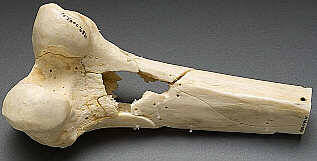
This is a fairly common question from victims of gunshots and their families. As you know, bullets are routinely left in place unless they are superficial. It may cause more damage to try to extract one, especially if it has come to rest in a deep location. But is there danger in leaving the bullet alone?

One of the classic papers on this topic was published in 1982 by Erwin Thal at Parkland Hospital in Dallas. The paper recounted a series of 16 patients who had developed signs and symptoms of lead poisoning (plumbism) after a gunshot or shotgun injury. The common thread in these cases was that the injury involved a joint or bursa near a joint. In some cases the missile passed through the joint/bursa but came to rest nearby, and a synovial pseudocyst formed which included the piece of lead. The joint fluid bathing the projectile caused lead to leach into the circulation.

The patients in the Parkland paper developed symptoms anywhere from 3 days to 40 years after injury. As is the case with plumbism, symptoms were variable and nonspecific. Patients presented with abdominal pain, anemia, cognitive problems, renal dysfunction and seizures to name a few.

Bottom line: Any patient with a bullet or lead shot that is located in or near a joint or bursa should have the missile(s) promptly and surgically removed. Any lead that has come to rest within the GI tract (particularly the stomach) must be removed as well. If a patient presents with odd symptoms and has a history of a retained bullet, obtain a toxicology consult and begin a workup for lead poisoning. If levels are elevated, the missile must be extracted. Chelation therapy should be started preop because manipulation of the site may further increase lead levels. The missile and any stained tissues or pseudocyst must be removed in their entirety.

Granted, this is a very old paper. Over the years, a few papers on the topic have popped up from time to time. In my next post, I’ll review a meta-analysis on this topic that was published just last year.

Reference: Lead poisoning from retained bullets. Ann Surg 195(3):305-313, 1982.

More On Lead Poisoning And Retained Bullets

Trauma professionals frequently have to leave bullets in patients. It is often more disruptive to go digging the projectiles out than to just leave them in place. But patients always want to know why and what the consequences might be.

In my last post, I discussed a very old paper on what we know about lead levels and retained bullets. Very recently, a meta-analysis was published that provides a better picture of this topic. They somehow managed to find over 2000 articles dealing with lead toxicity and bullets out there. But after someone had the pleasure of reviewing each of them, they found only 12 that had any meaningful or actionable information.

Here are the factoids:

  • All studies were observational (duh! It would be difficult to get your IRB to approve a study where patients were shot on purpose)
  • There were five cross-sectional studies, four case-control studies, and three prospective cohort studies
  • The studies were small, with a median of only 26 patients (range 15-120)
  • Eleven of the twelve studies showed an association with retained bullets and elevated blood lead levels
  • Three studies showed elevated blood levels if a fracture was present
  • The higher the number of retained fragments, the more likely lead levels were to be high
  • Higher lead levels were associated with retained fragments near a bone or joint
  • There were no good correlations with number of fragments and location vs actual lead toxicity

Bottom line: Even using meta-analysis, it is difficult to tease out meaningful answers to this question. That speaks to the low numbers of papers and their quality. However, this study does provide a little bit of guidance.

Retained bullet fragments are probably not a big worry in most patients. The bothersome cases are those where the fragments are in or near a bone or joint. And even though few patients actually developed lead toxicity, lead levels approaching 5 micrograms/dL can have physiologically significant negative effects. 

Recommendation: If your patient has a retained bullet fragment near a bone or joint, or they have “multiple” retained fragments (no good definition of this), they should have blood lead levels measured every three months for a year. If the level is rising, and certainly if it reaches the 5μ/dL level, attempts should be made to remove the fragments.

Reference: Lead toxicity from retained bullet fragments: A systematic review and meta-analysis. J Trauma 87(3):707-716, 2019.

Can Lead Poisoning Occur After A Gunshot?

This is a fairly common question from victims of gunshots and their families. As you know, bullets are routinely left in place unless they are superficial. It may cause more damage to try to extract one, especially if it has come to rest in a deep location. But is there danger in leaving the bullet alone?

One of the classic papers on this topic was published in 1982 by Erwin Thal at Parkland Hospital in Dallas. The paper recounted a series of 16 patients who had developed signs and symptoms of lead poisoning (plumbism) after a gunshot or shotgun injury. The common thread in these cases was that the injury involved a joint or bursa near a joint. In some cases the missile passed through the joint/bursa but came to rest nearby, and a synovial pseudocyst formed which included the piece of lead. The joint fluid bathing the projectile caused lead to leach into the circulation.

The patients in the Parkland paper developed symptoms anywhere from 3 days to 40 years after injury. As is the case with plumbism, symptoms were variable and nonspecific. Patients presented with abdominal pain, anemia, cognitive problems, renal dysfunction and seizures to name a few.

Bottom line: Any patient with a bullet or lead shot that is located in or near a joint or bursa should have the missile(s) promptly and surgically removed. Any lead that has come to rest within the GI tract (particularly the stomach) must be removed as well. If a patient presents with odd symptoms and has a history of a retained bullet, obtain a toxicology consult and begin a workup for lead poisoning. If levels are elevated, the missile must be extracted. Chelation therapy should be started preop because manipulation of the site may further increase lead levels. The missile and any stained tissues or pseudocyst must be removed in their entirety.

Granted, this is a very old paper. Over the years, a few papers on the topic have popped up from time to time. In my next post, I’ll review a meta-analysis on this topic that was published just last year.

Reference: Lead poisoning from retained bullets. Ann Surg 195(3):305-313, 1982.